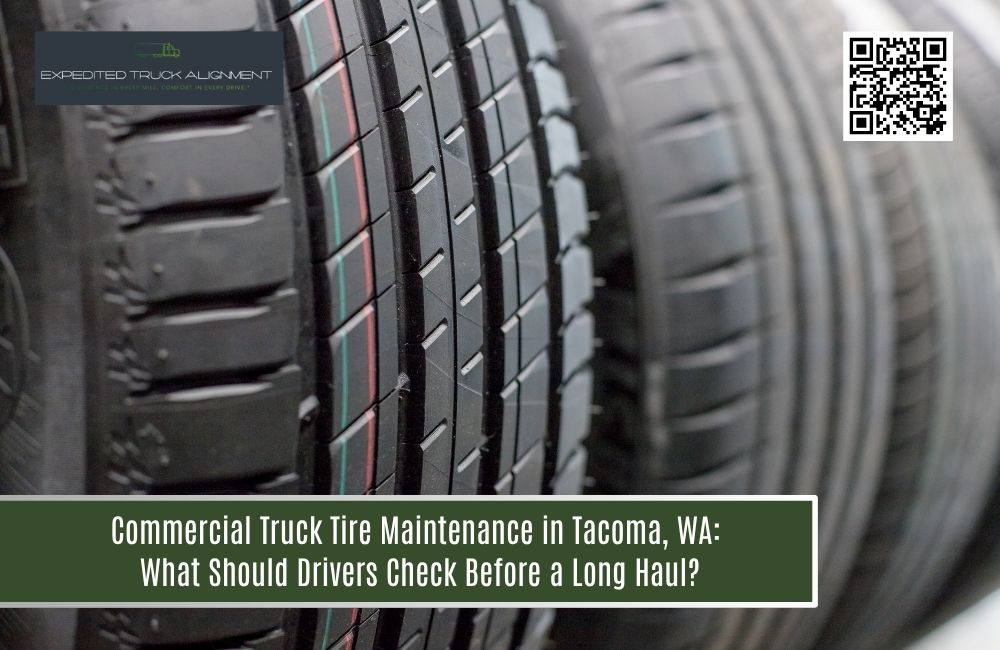
Commercial Truck Tire Maintenance in Tacoma, WA: What Should Drivers Check Before a Long Haul?
A long-haul trip can place thousands of miles between a commercial truck and its next scheduled maintenance appointment. Before leaving Tacoma, WA, drivers should inspect tire pressure, tread condition, sidewalls, valve stems, wheel assemblies, and visible signs of uneven wear. These checks help identify problems that could lead to roadside delays, unexpected tire replacement, or handling concerns.
Proper maintenance of commercial truck tires Tacoma, WA involves more than checking whether the tread looks acceptable. Tire condition, vehicle loading, suspension performance, and truck alignment all influence how reliably a vehicle performs during extended travel. For truck drivers, bus operators, RV owners, and fleet managers, understanding these connections makes pre-trip inspections more useful.
Why Long-Haul Tire Inspections Matter
Highway driving creates sustained heat, repeated tire flexing, and continuous contact with the pavement. Small problems that seem insignificant during local driving can become more serious over long distances.
A slow pressure leak, for example, may cause excessive sidewall flexing as the vehicle travels. An existing tread injury can worsen under repeated loading.
Inspecting truck tires before departure provides an opportunity to address these conditions while professional service is still accessible.
Drivers should follow applicable pre-trip inspection requirements and manufacturer recommendations rather than relying solely on appearance.
Check Tire Pressure Before Departure
Inflation pressure is one of the most important factors affecting tire performance.
Underinflated tires generate additional heat because their sidewalls flex more than intended. Excessive inflation can change the tire's contact with the road and contribute to irregular wear.
Pressure should be measured with an accurate gauge when tires are cold, using the appropriate inflation specification for the tire and actual operating load.
Drivers should also compare pressure across dual assemblies.
A tire that repeatedly loses pressure needs further investigation, even when it can temporarily be reinflated.
Examine Tread Depth and Surface Condition
Tread inspection should include more than looking for obvious bald spots.
Drivers should examine the entire visible tread surface for cuts, embedded objects, exposed reinforcement, unusual wear, and damage between tread blocks.
Tread depth should be measured using an appropriate gauge and evaluated against applicable requirements for the tire position.
For semi truck tires, steer and non-steer positions may have different minimum tread-depth requirements.
Tires approaching their service limits deserve attention before a long journey, especially when the route includes extended highway travel or demanding weather conditions.
Look Closely at Sidewalls
Sidewalls support the tire as it flexes under load.
Bulges, deep cuts, exposed cords, and other structural damage can indicate a tire that requires professional evaluation.
Drivers should also examine the area near the bead and rim for visible damage.
A sidewall bulge should never be treated as a cosmetic issue.
If structural damage is suspected, the tire should be assessed before the vehicle returns to service.
Inspect Dual Tire Assemblies Carefully
Dual tires must operate together while carrying substantial weight.
Differences in inflation, overall diameter, or tire condition can cause unequal load sharing.
Drivers should inspect both tires, including the space between them, where debris or hidden damage may be difficult to see.
A lodged object between dual tires can damage sidewalls during operation.
Professional inspection at a truck tire shop may be necessary when access is limited or the assembly shows unusual wear.
Watch for Irregular Tread Patterns
Uneven wear can reveal mechanical conditions that deserve attention before departure.
Feathering, concentrated shoulder wear, diagonal patterns, and irregular tread surfaces may indicate problems involving inflation, suspension movement, wheel balance, or axle geometry.
Not every unusual pattern requires immediate tire replacement, but its cause should be understood.
A professional commercial truck wheel alignment inspection can help determine whether incorrect wheel angles or axle relationships are contributing to the damage.
Identifying the problem before a long trip may prevent additional tread loss.
Check Wheel and Rim Condition
Tire maintenance also includes the components supporting the tire.
Drivers should look for visible rim damage, cracks, unusual corrosion, missing fasteners, and signs of movement around wheel mounting areas.
Wheel-end concerns can affect safety even when the tire itself appears serviceable.
Any suspected wheel or fastening problem requires qualified inspection.
Drivers should never assume that a tire is road-ready simply because its tread and inflation appear normal.
Consider Tire Age and Service History
Mileage alone does not determine whether a tire is suitable for another long trip.
Tire age, storage conditions, previous repairs, operating loads, and exposure to heat can influence serviceability.
Fleet records should identify installation dates, tire positions, repairs, and recurring pressure concerns.
A tire with adequate tread may still require closer evaluation if its history includes repeated air loss or suspected structural damage.
Understanding service history helps operators make better replacement decisions.
Why Alignment Matters Before Long-Distance Travel
Incorrect wheel geometry can create continuous tire scrub during highway driving.
Even small alignment deviations may produce substantial wear when a vehicle travels hundreds of miles each day.
A semi truck wheel alignment check is worth considering when the driver notices steering changes, repeated tire wear, or an off-center steering wheel.
However, alignment should not be treated as a substitute for inspecting worn steering and suspension components.
Mechanical stability is necessary for accurate measurements.
Trailer Tires Need Equal Attention
Trailer tires can develop serious problems without producing obvious steering feedback.
Drivers should examine tread, inflation, sidewalls, and wheel condition across every trailer axle.
Incorrect axle tracking can create directional scrub that damages tread over time.
When recurring trailer tire wear appears, tractor trailer alignment may help identify whether the trailer follows the tractor correctly.
A properly maintained tractor cannot compensate for every problem occurring behind the fifth wheel.
Check Suspension Components Before the Journey
Suspension conditions affect tire loading and vehicle stability.
Worn bushings, damaged springs, leaking air bags, and loose mounting components can change how weight is distributed across tire positions.
Drivers should report unusual ride height, visible damage, or changes in handling.
Professional heavy duty wheel alignment may be appropriate after repairs that affect axle position or suspension geometry.
Correcting mechanical problems before departure helps reduce the likelihood of repeated tire damage.
Match Tire Condition to the Route
A commercial vehicle travelling from Tacoma toward Portland, Seattle, or Eastern Washington may encounter different temperatures, pavement conditions, traffic patterns, and weather.
Extended interstate travel produces different demands from frequent urban deliveries.
Drivers should consider expected operating conditions when evaluating tire readiness.
For buses and RVs, passenger loads, storage periods, and seasonal travel patterns also influence maintenance needs.
Tire preparation should reflect the vehicle's actual use rather than a generic checklist alone.
Understand When Alignment Service Is Necessary
Not every long trip requires a new alignment appointment.
However, recent road impacts, suspension repairs, recurring tire wear, and changes in steering behavior can justify inspection.
A professional semi truck alignment service can measure relevant wheel angles and axle relationships to identify geometry concerns.
For larger combinations, 18 wheeler alignment may require examining steer, drive, and trailer axle positions.
The appropriate procedure depends on vehicle configuration and manufacturer specifications.
Fleet Maintenance Requires Consistent Documentation
Fleet managers benefit from recording tire pressure, tread depth, repairs, and replacement history.
These records help identify vehicles that repeatedly develop problems at particular wheel positions.
Coordinating fleet truck alignment evaluations with preventive maintenance can also reduce scheduling disruptions.
Rather than waiting for tire failure, operators can use maintenance history to identify developing concerns.
Consistent documentation supports better purchasing decisions and more predictable vehicle availability.
Tacoma's Transportation Environment
Tacoma is an important commercial transportation center, with freight activity connected to the Port of Tacoma, Interstate 5, and surrounding distribution facilities.
Trucks travelling through Lakewood, Fife, Federal Way, Puyallup, and Olympia encounter a mixture of interstate routes and local industrial roads.
Frequent loading, turning, and pavement transitions can place additional demands on tires and suspension systems.
For local operators, scheduling inspections before regional or interstate trips provides an opportunity to address concerns without interrupting an active delivery.
When Should Drivers Visit a Tire Specialist?
Professional service is appropriate when tires show structural damage, repeated pressure loss, severe irregular wear, or other conditions that cannot be safely evaluated during a routine inspection.
A technician can examine the tire assembly and determine whether repair, replacement, balancing, or additional mechanical diagnosis is needed.
When tread wear suggests incorrect geometry, commercial truck alignment measurements may be recommended.
The objective is to identify the actual cause rather than replace parts unnecessarily.
Frequently Asked Questions
What should truck drivers check before a long haul?
Drivers should inspect tire pressure, tread depth, sidewalls, wheel condition, dual assemblies, and visible damage while following applicable inspection requirements.
Can a tire have good tread but still be unsafe?
Yes. Structural damage, excessive air loss, or other defects can make a tire unsuitable for service despite adequate tread depth.
Should a semi truck get alignment before every long trip?
No. Semi truck alignment should follow manufacturer guidance and vehicle condition, with additional checks when symptoms or repairs justify them.
Can tire pressure change during highway travel?
Yes. Pressure normally increases as tires warm. Drivers should follow manufacturer guidance rather than releasing air from properly inflated hot tires.
Does a trailer need separate tire inspection?
Yes. Trailer tires, wheels, and suspension components should be inspected independently of the tractor.
Can incorrect alignment shorten tire life?
Yes. Incorrect geometry can cause tire scrub and irregular tread wear, making timely truck wheel alignment checks valuable when warning signs appear.
Prepare Your Tires Before the Miles Add Up
Long-haul tire maintenance is most effective when drivers combine careful visual inspections with accurate pressure measurements, service records, and professional diagnosis when needed.
Recognizing damage, unusual wear, and mechanical warning signs before departure can help reduce roadside interruptions and protect tire investments.
For drivers and fleet operators in Tacoma and Lakewood, Expedited Truck Alignment & Tires provides commercial tire services, steering and suspension diagnostics, and alignment support for trucks and trailers throughout South Puget Sound.
Expedited Truck Alignment & Tires
Address: 11302 Steele St S, Lakewood, WA 98499
Phone: +1 (564) 200-3637
