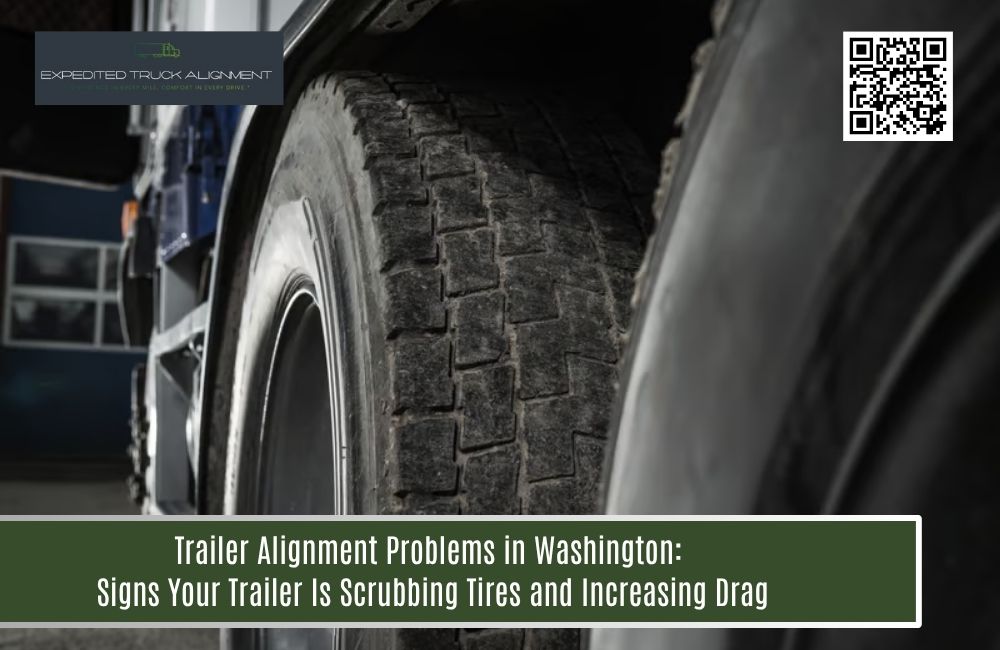
Trailer Alignment Problems in Washington: Signs Your Trailer Is Scrubbing Tires and Increasing Drag
A trailer that does not track correctly can quietly increase operating costs long before the driver sees a major failure. Poor truck alignment across the tractor-trailer combination can force tires to scrub instead of rolling cleanly, increase drag, and create uneven wear across trailer axles. For fleets operating in Lakewood, Tacoma, and South Puget Sound, identifying trailer alignment problems early can help protect tire life, improve tracking, and reduce unnecessary fuel and maintenance expenses.
Expedited Truck Alignment & Tires provides commercial alignment diagnostics, tire wear analysis, suspension service, and multi-axle support for trucks and trailers throughout the region. The focus is not simply on correcting measurements, but on identifying why the trailer is wearing tires or resisting the direction of travel.
What Tire Scrub Looks Like on a Trailer
Tire scrub occurs when a trailer tire is dragged slightly sideways as the vehicle moves forward. The tire may still rotate normally, but it is not following the same path as the rest of the vehicle.
Over time, this sideways movement creates friction and can remove tread faster than expected.
Common Signs of Trailer Scrub
Fleet operators may notice:
Diagonal wear across the tread
One shoulder wearing faster
Feathered tread blocks
Uneven wear between trailer axles
Tires that look dragged across the pavement
Repeated replacement on the same position
A trailer that appears offset behind the tractor
A professional truck tire shop can use these patterns as evidence during a trailer alignment inspection.
Why Trailer Axles Stop Tracking Correctly
Trailer alignment can change for several reasons. Normal wear, road impacts, suspension movement, damaged components, or previous repairs may shift axle position.
Common contributors include:
Worn suspension bushings
Loose mounting hardware
Bent or shifted axle components
Damaged hangers
Uneven ride height
Improper axle positioning
Previous collision or curb impact
Suspension repairs completed without final alignment verification
The cause should be confirmed before adjustments are made.
Drag Costs More Than Tires
A trailer that is not tracking straight creates resistance. The tractor must use additional effort to pull the trailer along the intended path.
That added resistance may contribute to:
Reduced fuel efficiency
More steering correction
Increased tire heat
Faster tread loss
Greater stress on suspension parts
Driver fatigue
Reduced vehicle stability
Even a relatively small alignment error can become expensive when a trailer travels thousands of miles each month.
Watch How the Trailer Follows the Tractor
Drivers may notice that the trailer seems to move slightly sideways or does not follow the tractor cleanly through a straight path.
This is sometimes described as dog tracking.
What Dog Tracking Means
Dog tracking occurs when the trailer body does not line up correctly with the tractor’s direction of travel. The trailer may appear shifted to one side even though the combination is moving forward.
Possible causes include axle misalignment, suspension movement, structural issues, or unequal positioning between axles.
This condition should be inspected because it can affect both tire wear and handling.
Tire Wear Can Identify Which Axle Needs Attention
Trailer tread patterns can help technicians determine where the problem may be occurring.
For example, diagonal wear on one axle may suggest tracking issues, while wear across several positions could point to a broader alignment or suspension problem.
When inspecting truck tires, technicians should compare:
Left versus right wear
Front versus rear trailer axle wear
Inner versus outer tread
Dual tire condition
Pressure differences
Tread-depth variation
The pattern often helps narrow the diagnosis.
Pressure Problems Can Make Alignment Wear Worse
Trailer alignment and inflation problems can occur at the same time.
Underinflated tires may flex excessively and develop shoulder wear. Overinflation can concentrate wear toward the center.
If a trailer is also misaligned, the combined effect can accelerate tread damage.
Dual Tires Need Consistent Pressure
Dual assemblies should be closely matched in pressure, diameter, and tread condition. One tire carrying more load than the other can increase heat and create irregular wear that complicates alignment diagnosis.
Proper maintenance of semi truck tires requires attention to the pair, not just the visibly damaged tire.
Suspension Condition Must Be Checked Before Alignment
Trailer axles cannot hold accurate alignment if the suspension allows unwanted movement.
Technicians may inspect:
Bushings
Hangers
Springs
Air bags
Torque arms
Mounting points
Shock absorbers
Related axle components
If these parts are loose or damaged, they may need repair before final alignment measurements are completed.
A South Puget Sound Fleet Example
Consider a regional fleet hauling refrigerated trailers between Tacoma, Kent, Puyallup, and Olympia.
One trailer begins wearing the inside shoulder of two tires unusually fast. The fleet replaces the tires, but the same pattern returns several months later.
A detailed inspection finds that one trailer axle is slightly out of position and a suspension bushing has excessive wear.
The fleet repairs the suspension component, completes the trailer alignment, and then verifies inflation and tire condition.
Instead of continuing to replace tires, the operator corrects the mechanical cause behind the wear.
How Trailer Alignment Affects New Tire Investment
New truck tires shop are a major operating expense. Installing them on a trailer with unresolved alignment problems can shorten their service life dramatically.
Before replacement, technicians should review:
Previous wear patterns
Axle position
Suspension condition
Tire pressure
Dual matching
Wheel condition
Trailer tracking
This creates a better starting point for the new tires and reduces the risk of repeating the same wear cycle.
Multi-Axle Trailers Require a Complete View
A multi-axle trailer should be evaluated as one system. Correcting only one axle without checking the relationship between all axles can leave the trailer tracking incorrectly.
Technicians should confirm that each axle works together and follows the intended centerline.
Why One Misaligned Axle Matters
If one axle points slightly differently from the others, the tires may fight each other as the trailer moves forward.
This can increase rolling resistance, create irregular tread patterns, and force the driver to make additional steering corrections.
Preventive Trailer Alignment for Fleets
Fleet operators do not need to wait for severe tire damage before checking trailer alignment.
An inspection may be appropriate after:
Suspension repairs
Major pothole impacts
Curb strikes
Collision repairs
Repeated tire replacement
Driver complaints about tracking
New tire installation
Visible diagonal wear
Including alignment checks in preventive maintenance can help catch problems before they affect multiple tire positions.
Keep Better Trailer Tire Records
Fleet managers should track trailer tires separately from tractor tires.
Useful records include:
Tire installation mileage
Axle position
Tread-depth measurements
Pressure history
Alignment dates
Suspension repairs
Rotation history
Removal reason
These records help identify trailers that repeatedly damage tires and reveal whether the problem is improving after repairs.
Local Trailer Alignment Expertise Near Tacoma
Expedited Truck Alignment & Tires serves commercial operators throughout Lakewood, Tacoma, Fife, Puyallup, Federal Way, Auburn, Kent, Olympia, Lacey, Gig Harbor, and surrounding South Puget Sound communities.
Services include total truck and trailer alignment, three-axle and multi-axle alignment, tire wear analysis, suspension repair, steering service, tire installation, balancing, rotation, and replacement.
The company is also an authorized HIXIH Tire Distributor in Washington.
Founder Luis Lopez brings more than a decade of hands-on experience in alignment, tire wear diagnostics, and suspension systems. His technical foundation began at Angel’s HD Suspension and Alignment under the guidance of his father, Angel Lopez.
Frequently Asked Questions
What does trailer tire scrub look like?
It often appears as diagonal wear, feathering, or rapid shoulder wear caused by the tire being dragged slightly sideways.
Can trailer alignment affect fuel economy?
Yes. Misalignment can increase rolling resistance and drag, which may contribute to higher fuel consumption.
Can a trailer cause the tractor to feel unstable?
Yes. Poor trailer tracking can influence steering correction, stability, and how the entire combination feels on the road.
Should trailer alignment be checked after suspension repairs?
Yes. Suspension work can affect axle position, so final alignment verification is often appropriate.
Does replacing tires fix trailer scrub?
No. Replacement addresses the damaged tire but not the mechanical cause. Alignment, suspension, pressure, and axle position should also be inspected.
Does Expedited Truck Alignment & Tires align commercial trailers?
Yes. The company provides total truck and trailer alignment, multi-axle diagnostics, tire services, and suspension support for commercial operators.
Stop Trailer Drag Before It Becomes a Tire Budget Problem
A trailer that scrubs tires is wasting tread and creating unnecessary resistance every mile it travels. Early diagnosis can help fleets protect tire investments, improve tracking, and avoid repeated replacements.
Contact Expedited Truck Alignment & Tires for trailer alignment diagnostics, tire wear analysis, and related suspension service in Lakewood, Tacoma, and South Puget Sound.
Contact Expedited Truck Alignment & Tires
Expedited Truck Alignment & Tires
Address: 11302 Steele St S, Lakewood, WA 98499
Phone: +1 (564) 200-3637
