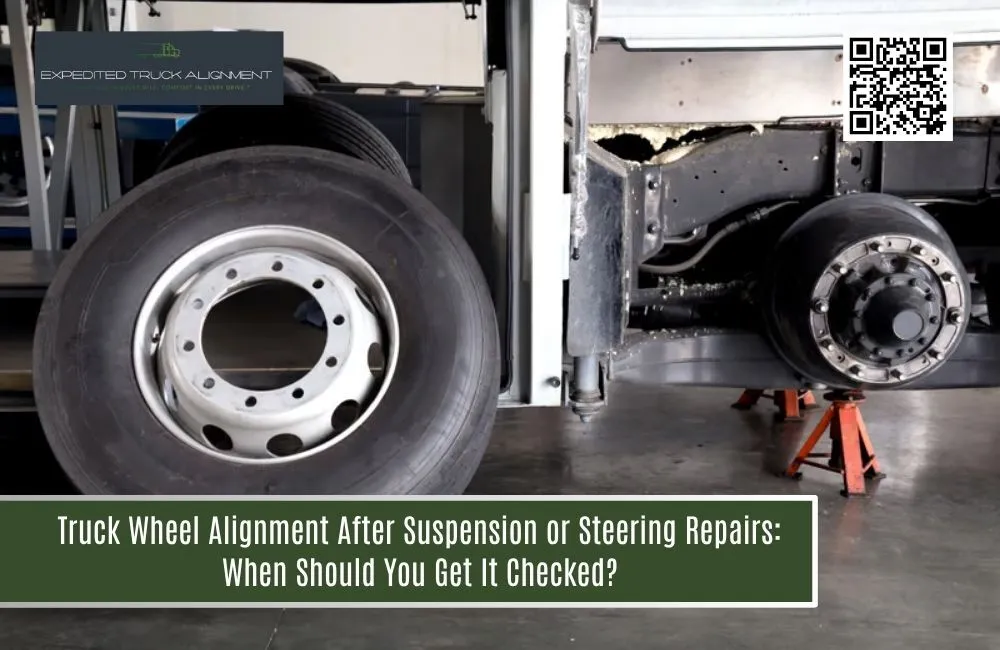
Truck Wheel Alignment After Suspension or Steering Repairs: When Should You Get It Checked?
Replacing a worn steering or suspension component can improve how a commercial truck handles, but the repair does not always finish when the new part is installed. Components such as kingpins, bushings, steering joints, springs, and suspension hardware help determine where the wheels and axles sit. When that relationship changes, a truck wheel alignment check may be necessary to confirm that the vehicle is ready to return to regular service.
For truck drivers and owners in Lakewood, Tacoma, and South Puget Sound, the practical question is not whether every repair automatically requires alignment. It is whether the work affected wheel position, axle geometry, ride height, or steering relationships. Understanding that distinction can help protect tires without paying for unnecessary service.
Why Repairs Can Change Wheel Geometry
A commercial truck’s alignment depends on several components working together.
Suspension parts locate and support the axles, while steering components control wheel direction. As these parts wear, they can develop movement that gradually changes the way a wheel sits or travels.
The previous alignment may have been measured while those worn parts were still installed.
Once a loose bushing, damaged joint, worn kingpin, or weakened suspension component is replaced, the wheel may return to a different position.
That is why alignment measurements taken before a significant repair may no longer describe the truck accurately afterward.
Kingpin Work Is a Good Reason to Recheck Alignment
Kingpins play an important role in steer-axle movement. Wear can contribute to looseness, changes in steering response, and irregular tire contact.
After kingpin replacement, technicians may need to verify wheel geometry rather than assume everything returned to the previous setting.
This becomes especially important if the old steer tires already showed abnormal wear.
A post-repair commercial truck wheel alignment provides measurements that reflect the condition of the repaired front end rather than the worn system that existed before service.
Bushing Replacement Can Change Axle Position
Bushings are easy to underestimate because their movement may be relatively small.
On a heavy-duty vehicle, however, small amounts of movement can matter.
Suspension bushings help control axle location while the truck accelerates, brakes, turns, and carries weight. As they deteriorate, an axle may shift slightly under operating forces.
Replacing those bushings removes the unwanted movement, but axle position should then be verified.
This is particularly important on tandem and multi-axle vehicles where one axle’s direction can influence how the rest of the truck tracks.
Steering Joint Repairs May Affect Toe and Steering Position
Steering joints and related linkage components transfer movement from the steering system to the wheels.
When worn parts are replaced, the relationship between those components may change.
The truck might feel noticeably tighter after the repair, yet the steering wheel could sit slightly off center or the toe setting may need verification.
Drivers should not assume that improved steering feel guarantees correct alignment.
The repair solves component looseness. Alignment measurements confirm how the wheels are positioned afterward.
Ride-Height Repairs Deserve Special Attention
Springs and air suspension systems influence more than ride comfort.
They establish the height at which the chassis and axles operate. If a truck previously sat too low, leaned to one side, or struggled to maintain consistent height, alignment measurements taken in that condition may not represent the repaired vehicle.
After correcting a spring, air bag, height-control, or related suspension problem, technicians should confirm that ride height is stable.
Then alignment can be evaluated under the corrected mechanical condition.
This sequence matters because accurate truck alignment depends on a suspension system that can maintain predictable geometry.
Not Every Shock Replacement Requires Alignment
Drivers sometimes assume that any suspension repair means an alignment must follow immediately.
That is not always the case.
A shock absorber primarily controls suspension movement. Replacing a shock may not directly change wheel geometry if no position-related components were disturbed.
However, the reason the shock was replaced still matters.
If the truck also has irregular tire wear, uneven ride height, steering changes, or other suspension concerns, an alignment inspection may still be worthwhile.
The repair type and existing symptoms should guide the decision.
Tire Wear Before the Repair Provides Useful Evidence
Before worn tires are removed, their tread should be examined carefully.
The pattern can reveal how the vehicle was operating before the mechanical problem was corrected.
For example, feathering may indicate directional scrub, while concentrated shoulder wear may justify closer examination of wheel geometry and suspension condition.
A knowledgeable semi truck tires can use the old tread pattern as part of the post-repair diagnosis.
Discarding worn tires without examining them can mean losing valuable evidence about what was happening before the repair.
Should Alignment Happen Before or After New Tires?
When steering or suspension repairs and tire replacement are both needed, repair order matters.
The mechanical problem should generally be corrected first.
Alignment can then be measured on a stable steering and suspension system. If tires are no longer safe or serviceable, replacement can be coordinated with that process.
What should be avoided is installing expensive new tires while the original geometry problem remains unresolved.
Fresh tread cannot compensate for loose steering parts or an axle that does not track correctly.
Watch the Truck Closely After Repairs
The first drives after steering or suspension work can provide useful feedback.
Pay attention to whether the steering wheel naturally sits centered, whether the truck holds its path consistently, and whether the previous pull or wandering condition has changed.
A truck that still requires frequent correction may need further investigation.
Drivers should also monitor tread over the following service period.
If a new wear pattern begins developing shortly after repairs, the vehicle should be rechecked rather than waiting until significant tread is lost.
Alignment Should Be Considered After Major Axle-Position Repairs
Repairs involving components that locate an axle deserve particular attention.
On multi-axle commercial vehicles, axle position affects more than the tires mounted directly to that axle. A drive axle that points slightly away from the vehicle centerline can influence the direction in which the entire truck wants to travel.
The driver may compensate at the steering wheel without realizing the source is behind the cab.
A comprehensive truck wheel alignment evaluation can determine whether the axles are working together rather than looking only at the front wheels.
Trailer Suspension Repairs Can Also Change Tracking
The same principle applies to trailers.
Suspension bushings, hangers, axle-related hardware, and other positioning components influence trailer tracking.
After repairs in these areas, the trailer may need alignment verification, particularly if it previously showed diagonal or rapid tire wear.
A tractor can be correctly aligned while a trailer continues to scrub tires.
For truck-and-trailer combinations, evaluating both units can prevent one unresolved geometry problem from affecting the entire vehicle.
A South Puget Sound Repair Scenario
Consider a regional truck operating between Lakewood, Tacoma, Kent, and Olympia.
The driver reports that the truck has gradually become less precise at highway speed. Inspection finds worn front-end components, including a steering joint that has developed excessive movement.
After the worn component is replaced, the steering feels tighter.
Instead of treating that improvement as proof that the job is finished, the technician checks the alignment under the repaired condition. Measurements show that toe requires correction.
The adjustment is completed before the truck returns to its normal route.
In this situation, the alignment is not an unrelated extra service. It verifies the geometry after the component responsible for controlling wheel position has changed.
Road Testing and Measurements Serve Different Purposes
A road test is useful, but it cannot replace alignment measurements.
A truck may feel reasonably straight even when geometry is contributing to slow tire wear. Likewise, a truck can pull despite acceptable alignment because tire condition, road crown, brake drag, or another mechanical issue is influencing direction.
Road testing tells the technician how the vehicle behaves.
Alignment equipment provides measurements.
Using both sources of information creates a stronger diagnosis than relying on either one alone.
How Soon Should Alignment Be Checked?
When a repair directly affects steering linkage, wheel position, axle location, or ride height, alignment should generally be considered as part of the repair process rather than delayed until the next routine service.
For repairs that do not alter geometry, the decision can depend on symptoms and tire condition.
Drivers should also schedule an earlier check if the steering wheel changes position, the truck develops a new pull, or unusual tread wear appears after service.
The objective is to verify the repaired vehicle before a small geometry problem has enough mileage to damage tires.
Frequently Asked Questions
Does replacing kingpins mean my truck needs an alignment?
An alignment check is often appropriate after kingpin work because the repair involves components that affect steer-wheel position and movement.
Should alignment be checked after replacing suspension bushings?
It can be important when the bushings control axle position. New bushings may change how the axle sits compared with the worn components.
Do new shocks automatically require commercial truck wheel alignment?
Not necessarily. Shock replacement alone may not alter geometry, but existing tire wear or handling symptoms can justify an alignment inspection.
Can steering repairs make the steering wheel off center?
Yes. Depending on the repair, steering relationships can change. An off-center wheel after service should be evaluated rather than ignored.
Should a trailer be aligned after suspension repairs?
If the repair affects axle position or the trailer previously showed abnormal tire wear, checking trailer alignment can be worthwhile.
Can I wait until the next tire change to check alignment?
If a repair has affected wheel or axle geometry, waiting may allow irregular wear to develop. Checking sooner can protect the tread already on the vehicle.
Make Alignment Verification Part of the Right Repairs
The best time for an alignment check is not determined by a calendar alone. It depends on what was repaired and whether that work could change wheel position, axle tracking, steering relationships, or ride height.
For truck owners in Lakewood, Tacoma, and surrounding South Puget Sound communities, paying attention to post-repair steering behavior and tire condition can prevent a completed mechanical repair from being followed by a new tire-wear problem.
When professional measurement is needed, Expedited Truck Alignment & Tires provides steering, suspension, tire, and alignment diagnostics for commercial trucks and trailers.
Expedited Truck Alignment & Tires
11302 Steele St S, Lakewood, WA 98499
+1 (564) 200-3637
